


Google Ads for Dropshipping: The Advanced Growth Playbook for Scaling Profitably
Clicks do not build profitable dropshipping businesses. Systems do. The operators who consistently scale are not simply buying more traffic. They are engineering a complete acquisition system in which product economics, search intent, feed quality, landing-page experience, bidding, remarketing, measurement, and experimentation work together.
That distinction matters because dropshipping has become far more sophisticated. A product can generate impressive revenue while quietly destroying cash through weak margins, expensive acquisition, refunds, poor delivery expectations, low repeat purchase rates, or inefficient advertising.
The goal of professional Google Ads management is therefore not to ask: "How can I get more sales?"
The better question is: "How can I acquire the right customer, for the right product, at an economically sustainable cost—and then scale that process without destroying its profitability?"

1. Start With Economics, Not Campaign Settings
Before choosing keywords, audiences, bidding strategies, or campaign types, determine what you can actually afford to pay for a customer.
Many inexperienced advertisers calculate profitability using only:
Selling Price − Product Cost = Profit
That is not enough.
Professional operators consider the full variable cost structure:
- Product acquisition cost
- Supplier and fulfillment costs
- Payment processing
- Shipping subsidies
- Marketplace or platform fees
- Discounts and coupons
- Refunds and chargebacks
- Customer support costs
- Advertising spend
Your advertising strategy should be built around contribution margin after variable costs, not top-line revenue.
Know Your Break-Even ROAS
If you retain $25 of contribution margin from a $100 order before advertising, spending more than approximately $25 to acquire that order makes the first transaction unprofitable.
This gives you an important baseline for deciding whether a Google Ads campaign is genuinely working.
2. Google Ads Works Best When You Capture Existing Buying Intent
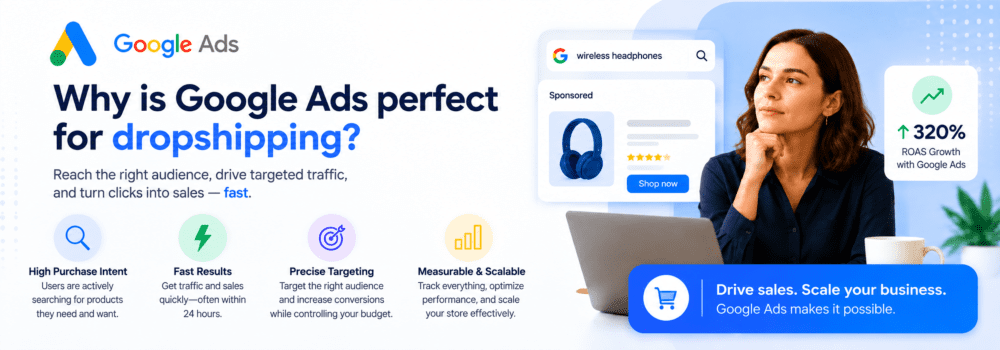
The biggest strategic advantage of Google is not simply reach. It is the ability to reach people while they are actively expressing intent.
There is an enormous difference between a person casually seeing a product while scrolling and someone searching:
- "buy noise cancelling headphones"
- "best wireless headphones under $150"
- "Sony WH-1000XM5 price"
- "RTX 5070 cheapest price"
- "Samsung 990 Pro 2TB deal"
These searches reveal different levels of awareness and commercial intent.
A sophisticated advertiser therefore separates traffic conceptually into stages such as:
| Intent | Example | Recommended Approach |
|---|---|---|
| Research | Best mechanical keyboards | Education, comparisons, broader discovery |
| Comparison | Keychron Q1 vs GMMK Pro | Comparison-focused landing experience |
| Commercial | Keychron Q1 price | Strong offer and product page |
| Transactional | Buy Keychron Q1 online | Conversion-focused advertising |
Do not send every searcher through the same experience.
The closer your advertisement and landing page match the customer's real intent, the stronger the overall acquisition system can become.
3. Your Product Feed Is Advertising Infrastructure
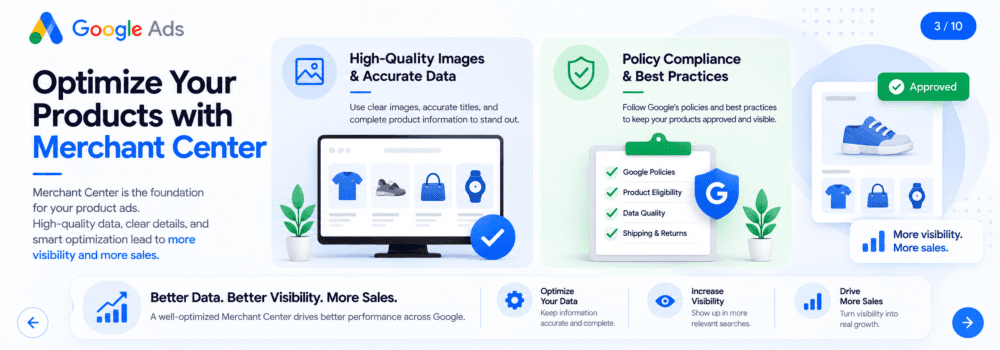
For e-commerce advertisers, Merchant Center should not be treated as a simple technical connection between a store and Google.
Your feed is one of the most important advertising assets in the business.
Google needs clean product information to understand what you sell, when your products are relevant, and how they should appear across shopping experiences.
Feed quality starts with accurate product information
Pay particular attention to:
- Product title
- Brand
- GTIN, UPC or other valid identifiers where applicable
- MPN
- Product type
- Google product category
- Price
- Availability
- Condition
- Images
- Shipping information
- Return information
Avoid filling titles with random keywords. The objective is not keyword stuffing. The objective is giving Google and the customer a highly accurate representation of the product.
A professional title structure
Depending on the product category, a useful structure could resemble:
Brand + Product Line + Model + Important Specification + Variant
For example:
Samsung 990 PRO 2TB PCIe 4.0 NVMe M.2 Internal SSD
This is substantially stronger than:
Amazing Fast SSD Hard Drive Best Gaming Storage Cheap Sale
The first helps identify the actual product. The second sacrifices data quality for keyword noise.
4. Use Performance Max as a System—Not a Black Box
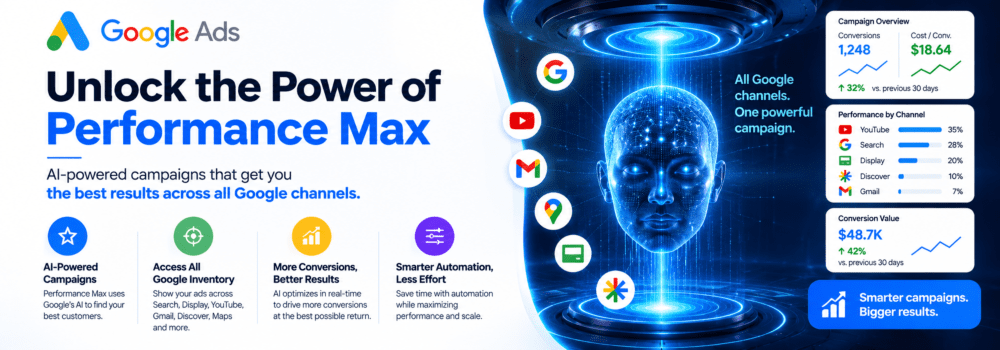
Performance Max gives advertisers access to Google's advertising inventory through a goal-based campaign powered heavily by automation.
That does not mean the advertiser has nothing left to do.
Automation magnifies the quality of the inputs you provide.
Poor product economics + weak tracking + mediocre creative + bad feed data + vague goals will not suddenly become a strong business because AI is involved.
Professional Performance Max management begins with:
- Reliable conversion tracking
- Accurate transaction values
- Strong Merchant Center data
- Clear product segmentation
- High-quality creative assets
- Useful audience signals
- Realistic bidding constraints
- Enough time and data to evaluate performance
Do not treat every SKU equally
A store may contain 5,000 products, but that does not mean 5,000 products deserve equal budget.
Separate products based on business value.
A useful structure can include:
- Hero products: proven products with attractive economics
- Growth products: promising products being actively tested
- Low-margin products: products requiring strict acquisition controls
- High-AOV products: products where conversion value matters significantly
- Seasonal products: demand heavily influenced by timing
- Unproven products: products that should not consume unlimited budget

5. Long-Tail Keywords: Follow Commercial Intent, Not Just Search Volume
Large-volume keywords are attractive because they appear to offer unlimited traffic.
But traffic volume and purchasing intent are not the same thing.
Compare:
Headphones
with:
best noise cancelling headphones for office calls
or:
Sony WH-1000XM5 black price
The longer query provides substantially more information about what the person wants.
This is why high-intent long-tail searches deserve serious attention.
Build keyword clusters around intent
Instead of simply collecting hundreds of disconnected keywords, organize them around commercial themes:
- Product: RTX 5070
- Price: RTX 5070 price
- Deal: RTX 5070 deals
- Purchase: buy RTX 5070
- Comparison: RTX 5070 vs RTX 4070 Super
- Specification: RTX 5070 12GB GDDR7
- Retail intent: RTX 5070 online
This approach lets your ad copy and landing pages mirror the customer's reason for searching.
Negative keywords protect your budget
Intent optimization also means deciding which searches you do not want.
Depending on the business, irrelevant traffic might include searches containing terms such as:
- manual
- repair
- driver
- jobs
- used
- free
These should never be added blindly. Examine your actual search-term data and determine which queries are economically irrelevant to your offer.

6. Remarketing: Most Shoppers Are Not Finished After the First Visit
A visitor who looked at a product, compared options, or placed something in a cart has given you information.
Treating that person identically to someone who has never heard of your store wastes that signal.
A mature remarketing strategy differentiates audiences based on behavior.
| Audience | Signal | Possible Strategy |
|---|---|---|
| Site visitor | General interest | Reintroduce brand or relevant category |
| Product viewer | Product-specific interest | Reinforce product/value proposition |
| Multiple product views | Comparison behavior | Help shopper choose |
| Cart abandoner | High purchase intent | Remove friction and recover purchase |
| Past customer | Existing relationship | Cross-sell, replenishment or upgrade |
Remarketing should answer the reason they did not buy
More ads alone are not a strategy.
A visitor may have left because:
- The price was not competitive
- Shipping was unclear
- Delivery appeared too slow
- The store lacked credibility
- The product information was incomplete
- They wanted to compare alternatives
- They were simply not ready
The strongest remarketing system therefore combines advertising with improvements to pricing, trust, product information and customer experience.

7. Your Landing Page Determines Whether Paid Intent Becomes Revenue
Google Ads can deliver the click.
The landing experience still has to close the gap between interest and action.
For dropshipping businesses, this is particularly important because unfamiliar stores must overcome trust barriers quickly.
The first screen should answer four questions
- What exactly is this product?
- Why should I want it?
- Why should I trust this seller?
- What should I do next?
Do not make a high-intent shopper hunt for basic information.
A strong product landing page should typically provide
- Clear product title
- High-quality product imagery
- Price and relevant savings information
- Stock or availability status
- Important specifications
- Primary benefits
- Shipping expectations
- Return information
- Trust and security indicators where legitimate
- Customer reviews when authentic
- Clear call to action
- Mobile-friendly experience
Page speed is part of acquisition economics
Every paid visitor costs money.
If a bloated page, oversized image, unnecessary script, pop-up overload, or poor mobile interface causes users to leave, you are not simply experiencing a technical problem—you are wasting acquisition budget.
Performance optimization and advertising optimization should therefore be treated as part of the same growth system.

8. Bidding Strategy Must Follow the Business Objective
Advertisers often ask:
"Which bidding strategy is best?"
There is no universal answer because the correct strategy depends on what you are optimizing.
| Objective | What Matters |
|---|---|
| Traffic acquisition | Qualified visits rather than raw click volume |
| Lead generation | Qualified conversion volume and acquisition cost |
| E-commerce growth | Conversion value and profitability |
| Margin-sensitive store | Revenue quality relative to acquisition cost |
Understand Target ROAS correctly
ROAS is calculated as:
Conversion Value ÷ Advertising Spend
If you spend $1,000 and attribute $4,000 in conversion value to the campaign:
ROAS = 400%
But a 400% ROAS is not automatically profitable.
If your gross margin is extremely thin, the business may still be losing money.
Conversely, some businesses with strong margins or valuable repeat customers can profitably operate at a lower first-order ROAS.
The metric hierarchy professionals should watch
- Contribution margin
- Customer acquisition cost
- Conversion value
- ROAS
- Conversion rate
- Average order value
- Refund rate
- Repeat purchase rate
- New-customer economics
9. A/B Testing: Turn Advertising Into a Learning Machine
Professional performance marketing is not built around opinions.
It is built around hypotheses.
Instead of saying:
"I think this headline is better."
Say:
"I believe emphasizing delivery speed will increase qualified conversion rate among high-intent shoppers. Let's test it."
What should you test?
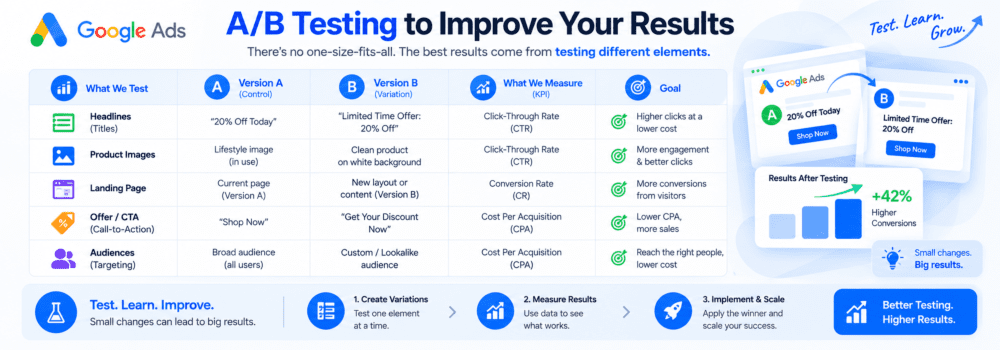
- Product titles
- Advertising messages
- Offers
- Images
- Landing-page headlines
- Page layouts
- Calls to action
- Bundles
- Free-shipping thresholds
- Product comparison experiences
- Trust messaging
- Audience strategies
Test one meaningful hypothesis at a time
If you simultaneously replace the headline, price presentation, primary image, CTA, navigation and product description, you may see a different result—but you will not know which change caused it.
Good experimentation produces reusable knowledge.
That knowledge compounds.
10. The Professional Dropshipping Growth Loop
When all of these elements work together, Google Ads stops being an isolated traffic source and becomes part of a measurable growth engine.
The operating loop looks like this:
- Select products with viable economics.
- Maintain accurate product and inventory data.
- Capture high-quality purchase intent.
- Send each audience to the right experience.
- Track meaningful conversion value accurately.
- Segment products based on economic performance.
- Remarket intelligently to qualified visitors.
- Test offers, creative and experiences.
- Move budget toward proven opportunities.
- Repeat the process with better data.
This is the difference between running advertisements and building a performance-marketing operation.
11. What Separates Professional Dropshippers From Amateur Advertisers
The amateur asks:
"Which product is trending?"
The professional asks:
"Does the product have sustainable economics and measurable demand?"
The amateur asks:
"How much revenue did the campaign generate?"
The professional asks:
"How much economically valuable revenue did we acquire after variable costs?"
The amateur asks:
"How do I get more traffic?"
The professional asks:
"Which traffic deserves more capital?"
And the amateur constantly searches for secret tactics.
The professional builds a system that keeps getting smarter.
Final Takeaway: Scale Intelligence Before You Scale Spend
Google Ads can become an extraordinarily powerful customer-acquisition channel for an e-commerce or dropshipping company—but advertising cannot rescue broken economics, unreliable suppliers, weak product data, uncompetitive offers or poor customer experiences.
The businesses most capable of scaling are those that connect advertising decisions directly to commercial reality.
Know your margin. Know your allowable acquisition cost. Maintain excellent product data. Understand search intent. Build trustworthy landing experiences. Measure conversion value. Segment products intelligently. Remarket with purpose. Test continuously.
Then—and only then—scale what the data proves deserves to be scaled.
Build a Smarter Commerce Strategy With BestMarket.us
BestMarket.us is being developed around a simple idea: online commerce works better when shoppers, sellers and businesses have better access to product, pricing and market intelligence.
Whether you are a seller, brand, dropshipper, service provider, affiliate partner or e-commerce business, BestMarket.us is building new ways to connect products with customers while helping shoppers compare their options more intelligently.
Explore BestMarket.us







Comments