


Building a great sound system is exciting. Finding the right product at the right price is usually the exhausting part. You open several retailer tabs, compare nearly identical model names, check shipping terms, inspect seller ratings, and still wonder whether you are choosing the right equipment.
Before comparing individual products, you need to answer a more important question: Do you need better speakers, a dedicated subwoofer, or both? The right answer depends on your room size, preferred listening volume, existing equipment, budget, and whether you care most about music clarity, cinematic impact, gaming immersion, or party-level output.
Speakers give music and movies their voice. A subwoofer gives them weight. This guide explains how both work, highlights ten products worth comparing, and helps you avoid the mistakes that commonly lead to disappointing audio performance.
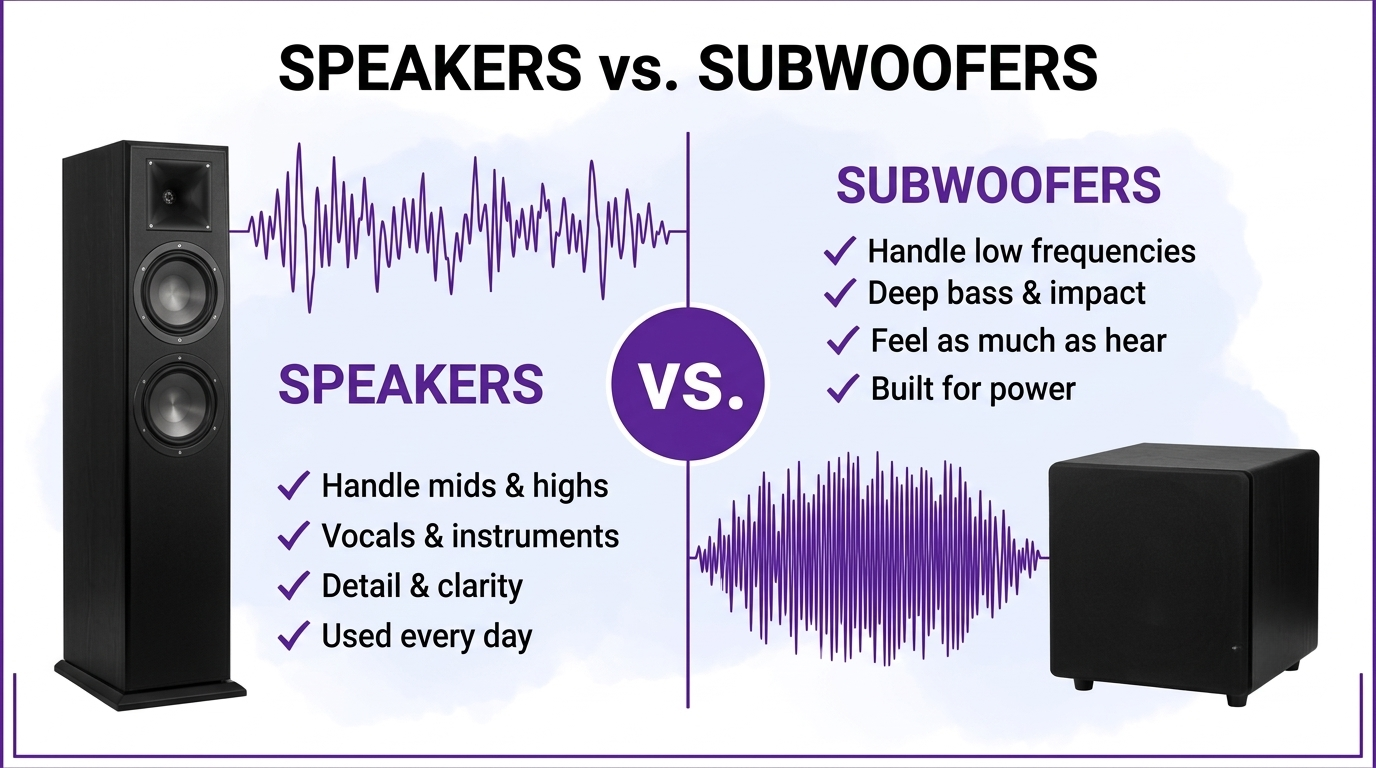
Speakers vs. Subwoofers: What Is the Difference?
Speakers reproduce a broad range of sound, including vocals, dialogue, instruments, mids, and high frequencies. They create the detail, imaging, and clarity you hear during everyday listening.
Subwoofers specialize in low frequencies. They reproduce the deep impact behind movie effects, kick drums, bass guitars, electronic music, and cinematic soundtracks.
You can use speakers without a subwoofer, but a properly matched subwoofer can make the whole system feel larger, fuller, and more effortless.

The Bass Specialists
— five subwoofers worth comparing


Klipsch Reference R-40PM Powered Bookshelf Speakers with Bluetooth, Modern Appearance, Black - Pair


What separates one subwoofer from another?
Driver size and amplifier power matter, but they do not tell the whole story. Enclosure design, frequency response, amplifier control, room correction, cabinet construction, and placement can influence real-world performance just as much as headline specifications.
Music listeners often prefer bass that sounds controlled, fast, and integrated with the main speakers. Home-theater listeners may prioritize deeper extension, higher output, and the ability to reproduce demanding low-frequency effects without obvious distortion.
SVS SB-1000 Pro vs. Klipsch R-120SW
These models represent two different approaches. The SVS SB-1000 Pro uses a compact sealed design and emphasizes control, flexibility, and integration. The Klipsch R-120SW uses a ported enclosure designed to deliver strong home-theater impact at a comparatively accessible price point.
- You prefer a compact sealed cabinet.
- You value app-based controls and fine adjustment.
- You listen to both music and movies.
- You prioritize controlled bass over maximum boom.
- You prioritize movie impact and ported output.
- You want a traditional home-theater subwoofer.
- You have enough space for a larger enclosure.
- You are comparing value-oriented options.
Product suitability depends on room size, calibration, placement, listening level, and current offer availability.
The All-Round Performers
— five speakers worth comparing


JBL Go 3: Powerful Sound - Portable Speaker with Bluetooth, Built-in Battery, Waterproof and Dustproof Feature - Black


For music
Prioritize tonal balance, stereo imaging, vocal clarity, and accurate reproduction rather than maximum loudness.
For movies
Look for clear dialogue, strong dynamics, wide dispersion, and compatibility with a suitable center channel and subwoofer.
For gaming
Accurate imaging helps reveal directional effects, while clean low-frequency output adds impact without hiding important environmental detail.
Build Around Your Listening Goal
Rather than choosing products only by price, start with the way you plan to use the system. Then compare compatible products within that category.
Choose compact powered or bookshelf speakers and add a controlled sealed subwoofer only when deeper bass is needed.
Start with accurate stereo speakers and pair them with a musical subwoofer that blends smoothly at the crossover.
Combine dynamic speakers, a matching center channel, and a subwoofer capable of reproducing deep movie effects cleanly.
Choose speakers and a subwoofer designed to operate within the same wireless platform for easier setup and control.
Five Costly Subwoofer-Buying Mistakes
A powerful specification sheet does not guarantee satisfying performance. Avoid these common mistakes before choosing your next audio upgrade.
Buying for specifications instead of the room
A large and powerful subwoofer can overwhelm a small room when placement, calibration, and room modes are not controlled. Match the product to the space and listening distance—not only to the largest specification you can afford.
Treating peak wattage as sound quality
Peak output is often a marketing figure. Continuous amplifier capability, distortion control, enclosure design, and driver quality provide more useful clues about everyday performance.
Ignoring crossover and phase
Incorrect crossover or phase settings can make the subwoofer sound disconnected from the main speakers. Begin with the receiver or manufacturer recommendation, then refine the result through calibration and listening.
Choosing placement based only on appearance
Room boundaries can exaggerate some frequencies and cancel others. Test more than one position before deciding where the subwoofer should permanently sit.
Buying before comparing the complete offer
Product price is only one part of the purchase. Shipping, seller reputation, warranty, return policy, condition, availability, and included accessories can affect the true value of an offer.
Which Audio Setup Is Right for You?
Use these priorities as a starting point, then compare the products and available offers that fit your room and budget.
| Your priority | Start with | What matters most | Suggested approach |
|---|---|---|---|
| Clear music and vocals | Quality stereo speakers | Imaging, balance, clarity | Add a musical subwoofer later if needed |
| Movies and home theater | Speakers plus subwoofer | Dialogue, dynamics, deep effects | Build around a compatible surround system |
| Apartment listening | Compact speakers or sealed subwoofer | Control at lower volume | Avoid excessive output and isolate vibration |
| Parties and outdoor use | High-output powered speaker | Volume, durability, portability | Prioritize output and power options |
| Gaming desk or small room | Compact active speakers | Near-field detail and imaging | Add a compact subwoofer only when needed |
Match the System to Your Room
Compact bookshelf or powered speakers can provide excellent results. A controlled 8- or 10-inch subwoofer may be enough, depending on output goals and placement.
Bookshelf or floor-standing speakers paired with a capable 10- or 12-inch subwoofer can provide balanced coverage.
Greater output may be necessary. Larger speakers, a more capable subwoofer, or two properly placed subwoofers may produce more even bass across several seats.
Prices and Availability Can Change
Open any product from the sliders above to review currently available marketplace offers, seller information, shipping terms, and other purchase details.
Explore Products on Bestmarket →Speaker and Subwoofer Questions
Do I need a subwoofer for music?
Not always. Good full-range speakers may provide enough bass for many listeners. A subwoofer becomes valuable when you want deeper extension, greater scale, or relief from asking smaller speakers to reproduce demanding low frequencies.
Is a 10-inch subwoofer large enough?
It can be sufficient for a small or medium room, depending on the product design and desired listening level. Driver size alone does not determine total performance.
Can I use two subwoofers?
Yes. Two properly placed and calibrated subwoofers can create more even bass across several seating positions. They are not used only to make the system louder.
What crossover setting should I use?
Around 80 Hz is a common starting point, but the ideal setting depends on the speakers, subwoofer, room, and receiver. Follow the manufacturer recommendation and refine the result through calibration.
Are wireless subwoofers completely wireless?
Usually not. Wireless commonly refers to the audio signal. The subwoofer still needs electrical power from a wall outlet.
Should I buy speakers or a soundbar?
A soundbar offers convenience and simple installation. Separate speakers generally provide greater flexibility, wider stereo separation, and a clearer upgrade path.
Does a larger subwoofer always produce better bass?
No. Larger drivers can support greater output, but amplifier quality, enclosure design, tuning, placement, and room response are also important.
Final Verdict: Which Setup Should You Buy?
- Choose speakers first when clarity, music, vocals, dialogue, and everyday listening matter most.
- Add a subwoofer when your current system lacks deep bass, cinematic impact, or low-frequency scale.
- Choose speakers and a subwoofer together when building a complete home-theater or full-range music system.
- Compare the complete offer, including price, seller, shipping, return policy, warranty, condition, and availability.





Comments